Спираль истории
Jun. 12th, 2020 01:57 pm![[personal profile]](https://www.dreamwidth.org/img/silk/identity/user.png) tijd
tijd
Продолжим эскурсы в историю. Сегодняшняя точка отсчета - июнь 1963. В этом месяце Валентина Терешкова слетала в космос. За хищения в крупных размерах был расстрелян Георгий Зуйков, директор Ленинградской областной оптово-торговой базы. Скандал в Ленинграде помог Леониду Брежневу пролезть на место Второго секретаря ЦК КПСС и таким образом получить платформу для последующей подготовки смещения Никиты Хрущева.
В городе Кривой Рог проходят массовые волнения, стихийно вызванные жестоким обращением милиции. Наученные уроком Новочеркасска, власти используют для разгона волнений внутренние войска и армию.
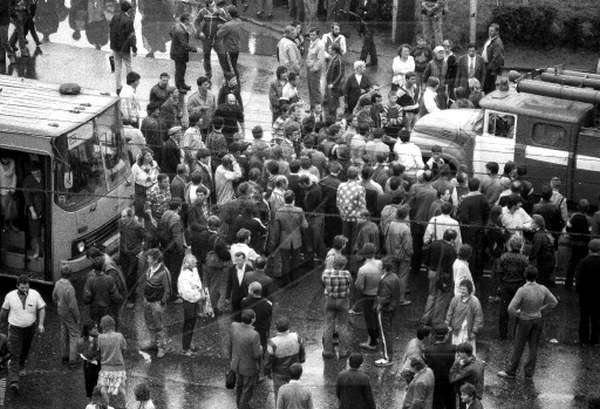
Все началось 16 июня 63-го в салоне трамвая. Возмущенные пассажиры тщетно пытались вразумить подвыпившего солдата. Закурив сигарету, тот, куражась, пускал дым в лицо попутчикам. Подгулявшего вояку милиционер Панасенко высадил на остановке «Маяк». Солдат, естественно, стал оказывать сопротивление. На подмогу милиционеру поспешили еще двое его коллег, патрулировавших на проспекте Металлургов. Как выяснилось, стражи порядка были тоже на подпитии. Задержание происходило в такой форме, что прохожие, минуту назад возмущавшиеся поведением солдата, дружно встали на его защиту. В какой-то момент служивому удалось вырваться, он попытался бежать, но милиционеры применили оружие. В результате были ранены двое случайных прохожих, а солдата все-таки потащили в ближайшее (Дзержинское) РОВД. С этого все и началось.
Весть о том, что пьяные милиционеры бьют солдата и проливают невинную людскую кровь, мигом облетела Соцгород. Возле Дзержинского отделения милиции стали собираться возмущенные толпы. Вначале просто требовали отпустить провинившегося солдата и наказать милиционеров, превысивших власть. Потом кто-то предложил отправить телеграмму в Москву чуть ли не самому Хрущеву с требованием наказать милиционеров-беспредельщиков. Толпа ринулась к телеграфу, но исполняющий обязанности прокурора города Закоморный отправку телеграммы запретил. Вместо этого в Москву ушла официальная информация о беспорядках, затеянных группой хулиганов.
Со всего Кривого Рога в район Соцгорода начали подтягиваться милицейские подразделения. По мнению властей, это должно было напугать бунтующих и вынудить их разойтись. Но страсти к тому времени уже накалились до предела. В сторону милиционеров полетели камни, те в ответ применили резиновые дубинки — нововведение хрущевских времен. Толпа прорвала милицейские кордоны. Ситуация выходила из-под контроля. Срочно было принято решение привлечь на подмогу милиции армейские силы. По тревоге были подняты и направлены в район Соцгорода подразделения местной танковой дивизии, из Днепропетровска были вызваны представители внутренних войск. Обстановка становилась взрывоопасной. Происходящее возле Дзержинского РОВД полностью соответствовало названию улицы, на которой все разворачивалось — Революционная. Бунтующие использовали вечное оружие пролетариата — булыжники, переворачивали милицейские и пожарные машины, а в конце концов — подожгли здание РОВД. В ответ раздавались выстрелы на поражение…
Подавление беспорядков заняло три дня. Подавляли жестоко — были убитые и раненые. Сколько именно? Вряд ли сегодня кто-нибудь сможет назвать точную цифру. В официальных документах указаны явно преуменьшенные данные: 7 человек убитых и 15 — раненых.
В городе говорили о сотнях покалеченных, отправленных в больницы и, как минимум, десятках убитых. Народная молва разносила слухи об убитом ребенке, случайно вышедшем на балкон, о расстрелянной беременной женщине. Произошедшее обрастало все новыми и новыми подробностями.
На следующий день начались массовые аресты. Как позже выяснилось, в толпе у здания Дзержинского РОВД, все эти дни находилось много «фотолюбителей» в штатском. Всех, кто имел несчастье попасть в объектив, опознавали и привлекали к административной и уголовной ответственности. Позже в ДК «Коммунист» состоялся показательный суд. Действия участников, хотя и квалифицировали как злостное хулиганство, но сроки давали серьезные, как за политические преступления — до 10 лет строгого режима.
https://web.archive.org/web/20130118075344/http://krivbass.in.ua/istoriia-i-sovremennost/bunt-na-sotcgorode-chto-eto-bylo
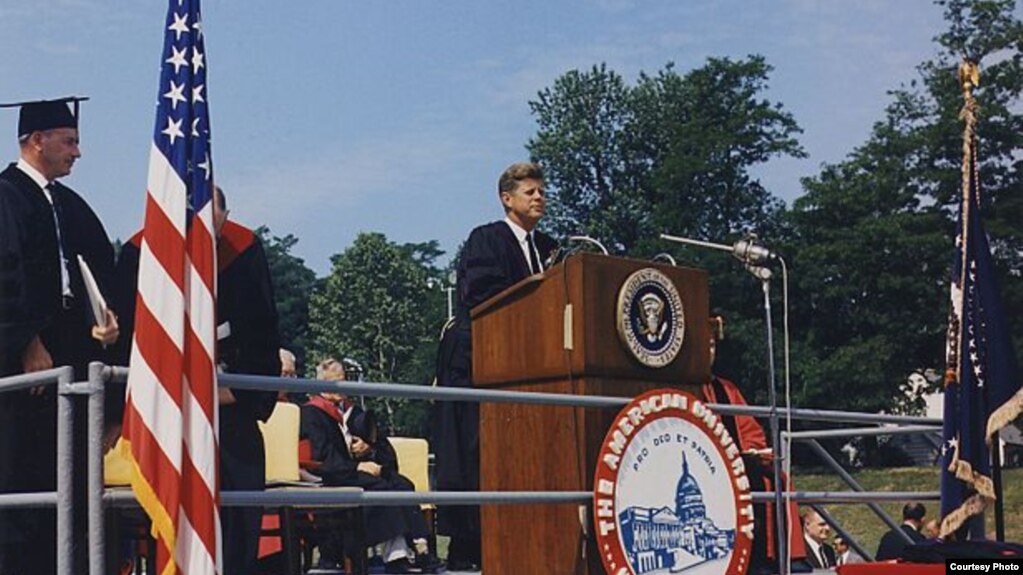
В июне 1963 президент Кеннеди произнес несколько из самых важных речей своего президентства.
Выступая перед выпускниками American University, он анонсирует свой подход в отношении к СССР - принимая во внимание кремлевскую паранойю, добиваться тем не менее договора о сокращении вооружений и мирного сосуществования. Между Кремлем и Белым домом установят "горячую линию", которая пригодится в октябре 2016 https://en.wikipedia.org/wiki/Moscow%E2%80%93Washington_hotline
Let us reexamine our attitude toward the Soviet Union. It is discouraging to think that their leaders may actually believe what their propagandists write. It is discouraging to read a recent authoritative Soviet text on Military Strategy and find, on page after page, wholly baseless and incredible claims--such as the allegation that "American imperialist circles are preparing to unleash different types of wars . . . that there is a very real threat of a preventive war being unleashed by American imperialists against the Soviet Union . . . [and that] the political aims of the American imperialists are to enslave economically and politically the European and other capitalist countries . . . [and] to achieve world domination . . . by means of aggressive wars."
Truly, as it was written long ago: "The wicked flee when no man pursueth." Yet it is sad to read these Soviet statements--to realize the extent of the gulf between us. But it is also a warning--a warning to the American people not to fall into the same trap as the Soviets, not to see only a distorted and desperate view of the other side, not to see conflict as inevitable, accommodation as impossible, and communication as nothing more than an exchange of threats.
No government or social system is so evil that its people must be considered as lacking in virtue. As Americans, we find communism profoundly repugnant as a negation of personal freedom and dignity. But we can still hail the Russian people for their many achievements--in science and space, in economic and industrial growth, in culture and in acts of courage.
Among the many traits the peoples of our two countries have in common, none is stronger than our mutual abhorrence of war. Almost unique among the major world powers, we have never been at war with each other. And no nation in the history of battle ever suffered more than the Soviet Union suffered in the course of the Second World War. At least 20 million lost their lives. Countless millions of homes and farms were burned or sacked. A third of the nation's territory, including nearly two thirds of its industrial base, was turned into a wasteland--a loss equivalent to the devastation of this country east of Chicago.
Today, should total war ever break out again--no matter how--our two countries would become the primary targets. It is an ironic but accurate fact that the two strongest powers are the two in the most danger of devastation. All we have built, all we have worked for, would be destroyed in the first 24 hours. And even in the cold war, which brings burdens and dangers to so many nations, including this Nation's closest allies--our two countries bear the heaviest burdens. For we are both devoting massive sums of money to weapons that could be better devoted to combating ignorance, poverty, and disease. We are both caught up in a vicious and dangerous cycle in which suspicion on one side breeds suspicion on the other, and new weapons beget counterweapons.
In short, both the United States and its allies, and the Soviet Union and its allies, have a mutually deep interest in a just and genuine peace and in halting the arms race. Agreements to this end are in the interests of the Soviet Union as well as ours--and even the most hostile nations can be relied upon to accept and keep those treaty obligations, and only those treaty obligations, which are in their own interest.
So, let us not be blind to our differences--but let us also direct attention to our common interests and to the means by which those differences can be resolved. And if we cannot end now our differences, at least we can help make the world safe for diversity. For, in the final analysis, our most basic common link is that we all inhabit this small planet. We all breathe the same air. We all cherish our children's future. And we are all mortal.
https://www.jfklibrary.org/archives/other-resources/john-f-kennedy-speeches/american-university-19630610
Американских параноиков-антикоммунистов слова о мире настораживают. Этим летом они начинают сплачиваться вокруг консервативного движения и кандидатуры Барри Голдуотера в качестве республиканского соперника Кеннеди на выборах 1964.
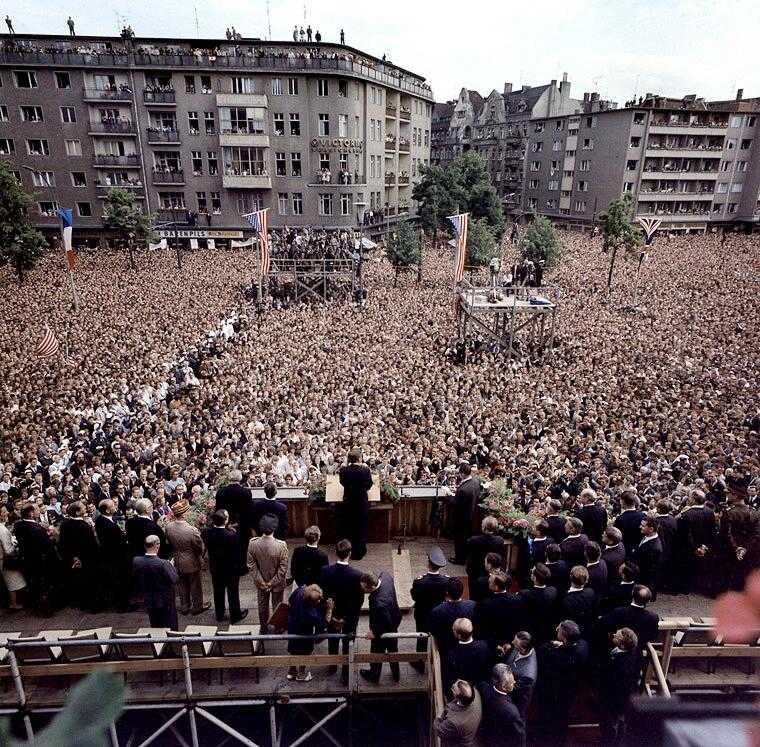
О различиях двух систем Кеннеди говорил позже в том же месяце у Берлинской стены.
"While the wall is the most obvious and vivid demonstration of the failures of the Communist system, for all the world to see, we take no satisfaction in it, for it is, as your Mayor has said, an offense not only against history but an offense against humanity, separating families, dividing husbands and wives and brothers and sisters, and dividing a people who wish to be joined together. <...>
Freedom is indivisible, and when one man is enslaved, all are not free. When all are free, then we can look forward to that day when this city will be joined as one and this country and this great Continent of Europe in a peaceful and hopeful globe. When that day finally comes, as it will, the people of West Berlin can take sober satisfaction in the fact that they were in the front lines for almost two decades."
https://www.jfklibrary.org/archives/other-resources/john-f-kennedy-speeches/berlin-w-germany-rudolph-wilde-platz-19630626
В тех же числах руководство КПК заявляет о несогласии с КПСС и получает в ответ открытое письмо ЦК КПСС, пересказанное персонажем Высоцкого:
"Когда вы рис водою запивали —
Мы проявляли интернационализм.
Небось когда вы русский хлеб жевали,
Не говорили про оппортунизм!
Вам не нужны ни бомбы, ни снаряды —
Не раздувайте вы войны пожар, —
Мы нанесём им, если будет надо,
Ответный термоядерный удар."
http://vysotskiy-lit.ru/vysotskiy/stihi/050.htm
Что касается "русского хлеба", то этим летом по СССР ударит неурожай, который заставит закупать зерно в США и Канаде.
Наблюдая за аркой истории, характерно, что через 26 лет после этих событий Берлинская стена рухнет, а руководство китайской компартии подавит волнения на площади Тяньаньмэнь, выбрав собственный вектор развития.
К идеи о неделимости свободы ("Freedom is indivisible, and when one man is enslaved, all are not free") Кеннеди обращался раннее (11 июня 1963) в телевизионном обращении к народу на тему расовых отношений.
"This Nation was founded by men of many nations and backgrounds. It was founded on the principle that all men are created equal, and that the rights of every man are diminished when the rights of one man are threatened.
Today we are committed to a worldwide struggle to promote and protect the rights of all who wish to be free. And when Americans are sent to Viet-Nam or West Berlin, we do not ask for whites only. It ought to be possible, therefore, for American students of any color to attend any public institution they select without having to be backed up by troops.
It ought to be possible for American consumers of any color to receive equal service in places of public accommodation, such as hotels and restaurants and theaters and retail stores, without being forced to resort to demonstrations in the street, and it ought to be possible for American citizens of any color to register to vote in a free election without interference or fear of reprisal.
It ought to be possible, in short, for every American to enjoy the privileges of being American without regard to his race or his color. In short, every American ought to have the right to be treated as he would wish to be treated, as one would wish his children to be treated. But this is not the case. <...>
We are confronted primarily with a moral issue. It is as old as the scriptures and is as clear as the American Constitution.
The heart of the question is whether all Americans are to be afforded equal rights and equal opportunities, whether we are going to treat our fellow Americans as we want to be treated. If an American, because his skin is dark, cannot eat lunch in a restaurant open to the public, if he cannot send his children to the best public school available, if he cannot vote for the public officials who will represent him, if, in short, he cannot enjoy the full and free life which all of us want, then who among us would be content to have the color of his skin changed and stand in his place? Who among us would then be content with the counsels of patience and delay?
One hundred years of delay have passed since President Lincoln freed the slaves, yet their heirs, their grandsons, are not fully free. They are not yet freed from the bonds of injustice. They are not yet freed from social and economic oppression. And this Nation, for all its hopes and all its boasts, will not be fully free until all its citizens are free. <...>
Now the time has come for this Nation to fulfill its promise. The events in Birmingham and elsewhere have so increased the cries for equality that no city or State or legislative body can prudently choose to ignore them.
The fires of frustration and discord are burning in every city, North and South, where legal remedies are not at hand. Redress is sought in the streets, in demonstrations, parades, and protests which create tensions and threaten violence and threaten lives.
We face, therefore, a moral crisis as a country and as a people. It cannot be met by repressive police action. It cannot be left to increased demonstrations in the streets. It cannot be quieted by token moves or talk. It is time to act in the Congress, in your State and local legislative body and, above all, in all of our daily lives.
It is not enough to pin the blame on others, to say this is a problem of one section of the country or another, or deplore the fact that we face. A great change is at hand, and our task, our obligation, is to make that revolution, that change, peaceful and constructive for all."
https://www.jfklibrary.org/learn/about-jfk/historic-speeches/televised-address-to-the-nation-on-civil-rights

Обращение было вызвано напряженной ситуацией в Алабаме. В этот день расистский губернатор Джордж Уоллес демонстративно встал в дверях Университета Алабамы, чтобы не допустить в него двух первых черных студентов. Алабама оставалась последним штатом с сегрегацией образования. Кеннеди своим указом передал национальную гвардию Алабамы в федеральное подчинение и настоял на выполнение судебного решения о приеме студентов.
On June 11, Malone and Hood pre-registered in the morning at the Birmingham courthouse. They selected their courses and filled out all their forms there. They arrived at Foster Auditorium to have their course loads reviewed by advisors and pay their fees. They remained in their vehicle as Wallace, attempting to uphold his promise as well as for political show,blocked the entrance to Foster Auditorium with the media watching. Then, flanked by federal marshals, Deputy Attorney General Nicholas Katzenbach told Wallace to step aside. However, Wallace interrupted Katzenbach and gave a speech on states' rights.
Katzenbach called President John F. Kennedy, who had previously issued a presidential proclamation demanding that Wallace step aside, and told him of Wallace's actions in ignoring the proclamation as it had no legal force. In response, Kennedy issued Executive Order 11111, which had already been prepared, authorizing the federalization of the Alabama National Guard. Four hours later, Guard General Henry Graham commanded Wallace to step aside, saying, "Sir, it is my sad duty to ask you to step aside under the orders of the President of the United States." Wallace then spoke further, but eventually moved, and Malone and Hood completed their registration.
In the days following the enactment, the National Guard were ordered to remain on the campus owing to a large Ku Klux Klan contingent in the surrounding area. Wallace and Kennedy exchanged volatile telegrams over it. Wallace objected to Kennedy ordering the Guard to remain on the campus and said that Kennedy bore responsibility if something happened. Kennedy responded stating that Executive Order 11111 made it clear that responsibility for keeping the peace remained with the State Troopers under Wallace's control and said he would revoke the order if assurances were made. Wallace refused stating he would not be intimidated and cited that Executive Order 11111 was passed without his knowledge.
https://en.wikipedia.org/wiki/Stand_in_the_Schoolhouse_Door

Через несколько часов после выступления Кеннеди у дверей своего дома в Миссисипи застрелен из ружья Медгар Эверс, активист движения за гражданские права. Эверс еще до Джеймса Мередита безуспешно пытался зарегистрироваться студентом Университета Миссисипи.
Убийца по имени Байрон Де Ла Беквит, член расистских организаций, был найден ФБР и передан в руки полиции. Жюри из тщательно отобранных белых присяжных не смогло вынести обвинительного заключения, и расистский террорист вышел на свободу. Во время судебных заседаний губернатор Миссисипи демонстративно заходил в зал, чтобы пожать ему руку.
Боб Дилан напишет об убийстве Эверса песню "Only a Pawn in Their Game", с который выступит в августе 1963 на митинге March on Washington. В песне среди виновных называется не только убийца, но и те, кто отравил ему мозги.
A South politician preaches to the poor white man
"You got more than the blacks, don't complain
You're better than them, you been born with white skin, " they explain
And the Negro's name
Is used, it is plain
For the politician's gain
As he rises to fame
And the poor white remains
On the caboose of the train
But it ain't him to blame
He's only a pawn in their game
http://www.bobdylan.com/songs/only-pawn-their-game/
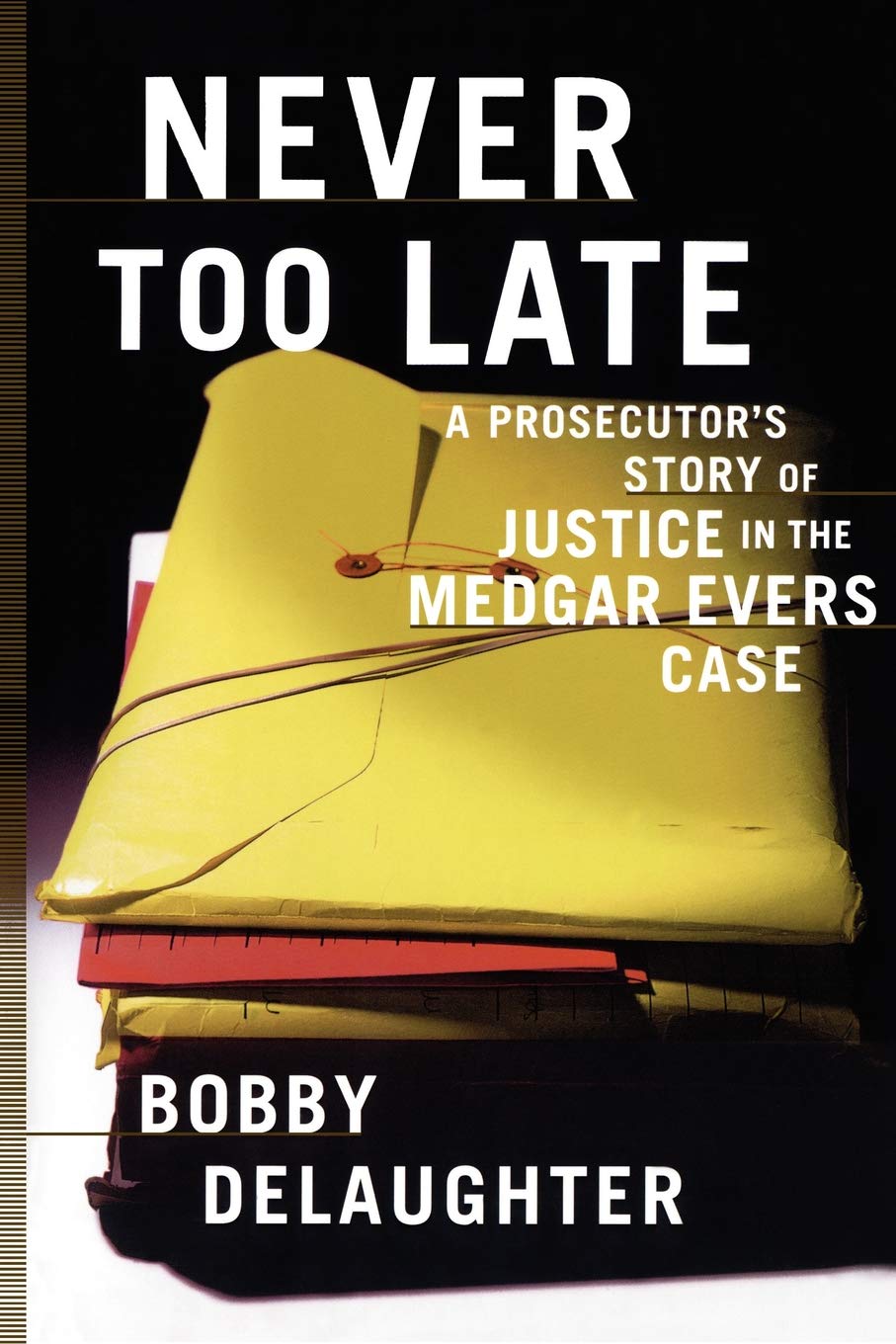
В 1970ых Беквит будет арестован и посажен в тюрьму на пять лет за подготовку покушения на главу отделения Anti-Defamation League в Новом Орлеане. Дело об убийстве Эверса возобновят в 1990ые. Благодаря расследованиям местных журналистов вскроются факты о мухлевании с подбором жюри, ложь в прошлых показаниях и личные признания Беквита в убийстве. Новый суд присяжных закончится пожизненным заключением. В 2001 80-летний Беквит умрет в тюрьме в ожидании апелляции.
In the late 1970s, the Clarion Ledger underwent a transformation. In 1983, it won a Pulitzer Prize for a series on the failure of school desegregation. Assistant District Attorney Bobby DeLaughter credits the paper's reports on the Sovereignty Commission as the driving force in reopening the Evers case.
"The case still left such a bad taste in your mouth," he said.
Slowly, one was assembled. Myrlie Evers sent prosecutors the transcript of the first trial; the state's copy had been destroyed. In June, DeLaughter confirmed recovery of the rifle and said he had found an obscure book written in 1975 by a member of the John Birch Society in which Beckwith allegedly confessed to the crime.
In the book, "Klandestine," Delmar Dennis, a disenchanted Ku Klux Klan member and FBI informer quotes Beckwith as saying at a Klan meeting:
"Killing that nigger gave me no more inner discomfort than our wives endure when they give birth to our children. We ask them to do that for us. We should do just as much. So let's get in there and kill those enemies, including the president, from the top down."
DeLaughter, born in Jackson, does not remember civil rights battles in his home town. At 37, he is the same age as Evers when he was slain. So repressed was the community's memory of those days that DeLaughter said he had never heard of the Evers case until 1975 when he read a newspaper story about Beckwith.
It recounted how Beckwith had been stopped in his car in New Orleans with a home-made bomb and directions to the house of the leader of the Anti-Defamation League of B'nai B'rith and was about to begin serving a five-year prison term.
In December, Beckwith was at his home in Signal Mountain, Tenn., with a giant Confederate flag hanging from the eaves when authorities arrived to arrest him and seek extradition to Jackson. Jailed in Chattanooga, he is appealing the extradition order and has vigorously denied killing Evers or making the remarks cited in "Klandestine."
Ronnie Barber, who runs a service station on Signal Mountain's main drag, said most people there were familiar with Beckwith's supremacist views.
"When my mother died," Barber recalled, "Beckwith came to the funeral, and he said to my nephew at the graveyard, 'This is the way a funeral ought to be. No niggers and no Jews.' "
https://www.washingtonpost.com/archive/politics/1991/02/09/reliving-the-evers-death/8579b557-1dfe-44c9-ab2d-e795522bf2f0/
In 1967, Mr. Beckwith ran for lieutenant governor and got more than 34,000 votes, finishing fifth in a field of six.
In 1973, he was stopped at a police roadblock in New Orleans. A bomb was found in his car, and prosecutors contended that Mr. Beckwith had meant to use it on the home of a leader of the Anti-Defamation League of B'nai B'rith. He was acquitted of federal charges but found guilty in state court of transporting explosives without a permit.
Mr. Beckwith was sentenced to several years in a Louisiana prison. In 1979, he became ill and, while in the prison infirmary, refused treatment from a nurse's aide who was black. A guard overheard Mr. Beckwith tell the aide that ''if I could get rid of an uppity'' Medgar Evers, he would have no trouble dealing with the ''no-account'' aide.
The guard testified in 1994 at Mr. Beckwith's third, and decisive, trial on murder charges. The trial came about in part because The Clarion-Ledger of Jackson published accounts of how the now-defunct Mississippi Sovereignty Commission, a pro-segregation state agency, had helped Mr. Beckwith screen potential jurors at his earlier trials.
A new generation of investigators and prosecutors went over the old evidence and dug up some new evidence. Mississippi had changed greatly in three decades, in part because of revulsion at the killing of Medgar Evers.
Mr. Beckwith wore a Confederate flag on his lapel during the trial. When the jury of eight blacks and four white people returned a guilty verdict on Feb. 5, 1994, he appeared dazed, as though not sure where he was.
https://www.nytimes.com/2001/01/23/us/byron-de-la-beckwith-dies-killer-of-medgar-evers-was-80.html
История рассказывается в голливудском фильме "Ghosts of Mississippi" (1996). За исполнение роли расистского убийцы актера Джеймса Вуда номинируют на Оскара. Ныне он - один из главных трампистов, распространяющих ядовитый контент в социальных сетях.
Trump last night retweeted Trump Jr. quote tweeting a QAnon account, along with retweeting James Woods yet again. Woods has tweeted multiple screenshots of "Q" posts, amplified QAnon content, & has also pushed Pizzagate. pic.twitter.com/hpmQSUuvsM
— Alex Kaplan (@AlKapDC) June 4, 2020
Роль прокурора, посадившего убийцу, исполнял Алек Болдуин, ныне прославленный пародийным изображением Трампа в Saturday Night Live.
Режиссер фильма Роб Райнер - один из самых последовательных критиков Трампа в Голливуде.
Donald Trump is a White Supremacist. And anyone who supports him, by definition, is a White Supremacist.
— Rob Reiner (@robreiner) June 11, 2020
Те, кто нападал на прокурора Бобби Делотера (роль которого в фильме исполнял Болдуин), как на предателя дела Юга, в конце концов дождались возмездия. Делотер стал судьей, но в 2009 был посажен в тюрьму на полтора года по обвинению в коррупции.
Bobby DeLaughter -- the prosecutor who secured the conviction in the infamous Medgar Evers Mississippi murder case -- is himself now headed to prison.
It was DeLaughter's dogged 1994 prosecution and the subsequent conviction of Ku Klux Klan member Byron De La Beckwith that helped trigger the reopening of dozens of civil rights cold cases.
DeLaughter became an instant hero of the civil rights movement. Alec Baldwin portrayed him in the 1996 movie, "Ghosts of Mississippi," and his closing statement was once dubbed one of the greatest closing arguments in modern law.
"Is it ever too late to do the right thing?" DeLaughter told the jury of eight blacks and four whites. "For the sake of justice and the hope of us as a civilized society, I sincerely hope and pray that it's not."
DeLaughter would go on to become a state judge in 2002. His years in the robe came to an end in 2009, when DeLaughter pleaded guilty to obstruction of justice for lying to an FBI agent in a far-reaching corruption probe that has rocked Mississippi's judicial system.
When he was sentenced in November, Byron De La Beckwith's son sat in the chamber wearing a Confederate flag pin on his red blazer. His father had also worn a Confederate pin during the 1994 trial.
DeLaughter is to begin serving his 18-month prison sentence today at a facility in Kentucky.
"The man has now been destroyed, politically and economically. It's that serious," said Charles Evers, the brother of Medgar Evers.
https://www.cnn.com/2010/CRIME/01/04/mississippi.medgar.evers.prosecutor/index.html

Когда происходили напряженные события июня 1963 года, Трамп, учащийся военизированной частной школы, отмечал 17-летие. На снимке он - второй слева. Мировоззрение молодого Дональда формировалось под влиянием отца, который этим летом начал подключать сына к своему бизнесу.
She seemed like the model tenant. A 33-year-old nurse who was living at the Y.W.C.A. in Harlem, she had come to rent a one-bedroom at the still-unfinished Wilshire Apartments in the Jamaica Estates neighborhood of Queens. She filled out what the rental agent remembers as a “beautiful application.” She did not even want to look at the unit.
There was just one hitch: Maxine Brown was black.
Stanley Leibowitz, the rental agent, talked to his boss, Fred C. Trump.
“I asked him what to do and he says, ‘Take the application and put it in a drawer and leave it there,’” Mr. Leibowitz, now 88, recalled in an interview.
It was late 1963 — just months before President Lyndon B. Johnson signed the landmark Civil Rights Act — and the tall, mustachioed Fred Trump was approaching the apex of his building career. He was about to complete the jewel in the crown of his middle-class housing empire: seven 23-story towers, called Trump Village, spread across nearly 40 acres in Coney Island.
He was also grooming his heir. His son Donald, 17, would soon enroll at Fordham University in the Bronx, living at his parents’ home in Queens and spending much of his free time touring construction sites in his father’s Cadillac, driven by a black chauffeur.
“His father was his idol,” Mr. Leibowitz recalled. “Anytime he would come into the building, Donald would be by his side.”
https://www.nytimes.com/2016/08/28/us/politics/donald-trump-housing-race.html
Leibowitz, now 88, managed several Trump buildings in the 1960s and 1970s, including the Wilshire Apartments in Jamaica Estates.
Early this week he recounted for The News a disturbing incident involving the use of the vile racial epithet that took place in 1963 involving father and son Trump.
At the time, Donald Trump was still a teenager but was learning his father's real estate business by constantly staying by his father's side, Leibowitz recalled.
At some point in 1963, Maxine Brown, a black registered nurse with impeccable credit, applied for an apartment at the Wilshire.
"She was calling me on a daily basis, wanted to know the status of the application. I had her checked out and she should have been accepted," Leibowitz recalled.
Leibowitz described what happened when he showed Brown's application to Fred Trump while Donald was standing alongside his father.
"I asked him, 'What do you want me to do with this application?' He said, 'You know I don't rent to n-----s. Put it in your desk drawer.' Donald was alongside of him. He was maybe 16, 17 years old at the time. He was learning the business of his father. He was right at his side."
Donald, Leibowitz said, had "no reaction" to his father's use of the slur.
Leibowitz said he recounted the incident to The New York Times last month, and the newspaper on Aug. 28 published the account of the interaction without including Fred Trump's statement with the racial epithet or the fact that Donald was there.
He said he did as he was told and tossed out the application. When Brown later filed a complaint with the city Human Rights Commission, Leibowitz was subpoenaed to testify but was not asked about the use of the epithet.
https://www.nydailynews.com/news/politics/donald-trump-dad-don-rent-n-s-1963-article-1.2774947


